Renew your COE,
or buy an EV?
It is the most common alternative people weigh when a COE expires, and the one with the most marketing behind it. The fuel savings are real. They are also much smaller than the gap they are meant to close. Here are the full ten-year numbers, both sides, with the workings shown.
The question underneath the question
When a COE expires, "should I switch to an EV?" is rarely a question about electric cars. It's a question about whether to keep the car you have or replace it — and the EV is simply the replacement that's being advertised hardest right now.
That matters, because the honest comparison isn't petrol versus electric. It's the cost of renewing what you own against the cost of acquiring something new, over the same period, counting everything. Fuel is one line in that comparison. It is not the biggest one.
We'll use the BYD Atto 3 throughout, because it's the mass-market EV most Singapore buyers actually cross-shop against keeping their car. The shape of the answer doesn't change much with a different model; the size of the gap does.
Ten years, both sides, everything counted
Here's the full picture. Renewal figures come from the current PQP and update automatically with LTA's published data; the EV side tracks BYD's list pricing and MAS financing rules.
| Renew your COE | New BYD Atto 3 | |
|---|---|---|
| Cash on day one | $0no downpayment on a renewal | ~$74,00040% under MAS rules |
| The car itself | COE (PQP) ~$123,000 | ~$185,000 OTRcar base + current COE premium |
| Interest | ~$22,000 | ~$18,000 |
| Road tax, 10 years | ~$9,000 | ~$22,000 |
| Fuel / charging | ~$35,000 petrol | ~$18,000 electricity |
| 10-year total | ~$190k | ~$243k |
The gap is roughly $53,000 — and that's after giving the EV full credit for cheaper energy.
Renewing forfeits your PARF rebate. We've kept it out of the table above because it isn't a cost you pay — it's a benefit you give up. It belongs in your decision, and we cover it properly in the rebates guide. Counting it would narrow the gap, not close it.
The downpayment nobody negotiates around
The single largest practical difference isn't in the ten-year total. It's what you need in your bank account before you can drive anywhere.
Under MAS rules, a car with an OMV above $20,000 requires a 40% downpayment. The Atto 3's OMV is around $28,000, so it's firmly in that bracket. On roughly $185,000 OTR, that's about ~$74,000 in cash, before the bank will process anything. There is no version of this you can negotiate.
TDSR caps your total monthly debt — including your mortgage — at 55% of income. Plenty of buyers who can find the downpayment still fail here. A COE renewal is a much smaller monthly commitment, so it clears the same test far more easily.
A renewal asks for nothing upfront. Your first payment is the first monthly instalment after approval. For most people that difference — $74,000 today versus $0 today — decides the question well before the ten-year totals do.
Yes, EVs are cheaper to run
We're not going to pretend otherwise. On roughly 17,500km a year, a typical 1.6L petrol car burns about $290 a month in fuel. The Atto 3 costs roughly $150 a month to charge at average public rates. Over ten years that's about $17,000 saved.
That's a real number and worth having. It is also about a third of the gap. Put plainly: the fuel savings are genuine, and they don't come close to paying for the car.
| Petrol (your current car) | Electricity (Atto 3) | |
|---|---|---|
| Assumption | ~7L/100km at ~$2.80/L | ~16kWh/100km at ~$0.55/kWh |
| Monthly | ~$290 | ~$150 |
| Over 10 years | ~$35,000 | ~$18,000 |
If you can charge at home overnight on a lower tariff, the saving improves — and the EV still lands roughly $40,000 more expensive over the decade. Home charging changes the number. It doesn't change the answer.
Three costs the showroom doesn't lead with
Road tax is two to three times higher
An Atto 3 pays roughly $2,200 a year in road tax once the EV flat component is included. A typical 1.6L petrol car pays around $740. That's about $15,000 more across ten years — a bigger number than most people expect, and one that never appears on a showroom comparison sheet.
Charging is still a daily logistics problem
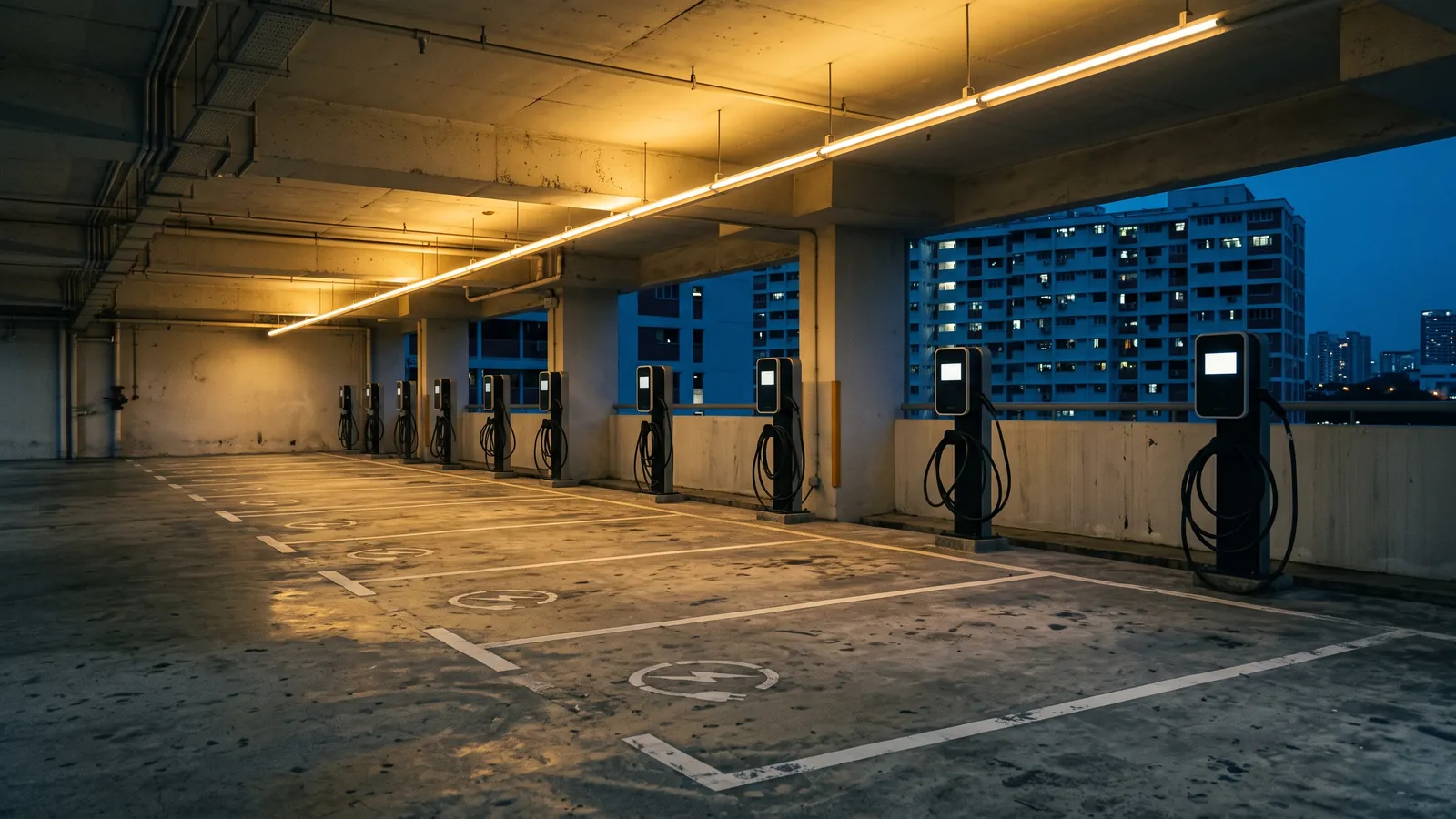
Around 80% of Singaporeans live in HDB flats, where guaranteed overnight home charging is the exception rather than the rule. Public charger availability, queue times at peak, and planning longer trips around charge stops are real recurring friction — not dealbreakers for everyone, but worth being honest about before you commit.
A new car depreciates hardest at the start
A new EV loses meaningful value the day it leaves the showroom. Your existing car is already past that curve — the steepest depreciation happened years ago and you've already paid for it. The 2026 PARF revision sharpens this further: rebates on newly registered cars are capped at $30,000 and fall to 5% of ARF by year ten, which weakens the residual value of anything bought new from here.
Where these numbers come from
Every figure above is traceable, and we'd rather show the workings than ask you to trust a conclusion:
Live from LTA's published COE bidding data. The PQP is the average of the previous three months' premiums, recalculated whenever you load this page.
BYD Atto 3 modelled as car base plus the current Cat A premium, so both sides of the comparison move together as COE prices shift.
MAS rules: 40% down where OMV exceeds $20,000, 7-year maximum bank tenure. A renewal has neither cap.
The EV price includes current incentives — the EV Early Adoption Incentive (45% off ARF, capped at $7,500 in 2026, down from $15,000) and the VES Band A1 rebate. Dealer pricing already reflects both.
Worth saying plainly: the incentives are already counted. The gap isn't an artefact of ignoring them. It survives them.
The objections worth taking seriously
"Won't petrol cars be banned anyway?"
Singapore's phase-out applies to new registrations from 2030, not to cars already on the road. Renew your COE today and you're entitled to drive that car for the full renewal period. No existing vehicle is being forced off the road at the end of the decade. It's a fair thing to check; it just doesn't change a renewal decision made now.
"Isn't a ten-year-old car a reliability risk next to something new?"
A reasonable concern, and the reason we don't ask anyone to renew blind. Every Meyer renewal includes a free vehicle health check (worth $150 + GST), plus a $200–250 credit toward a one-year engine and gearbox warranty. If the inspection finds something that changes the maths, you'll know — and we'll tell you straight. Our renew-or-scrap guide covers what an inspection should actually look for.
"I've already decided I want an EV"
Then buy the EV. Cost isn't the only valid input, and there are perfectly good reasons to want one that have nothing to do with a spreadsheet — how it drives, how it sounds, what you want to be driving. Our job is to make sure the number is in front of you, not to talk you out of a decision you've made with your eyes open. If an EV is right for you, we'll say so.
Renewing wins on cost, clearly, and it isn't close. It wins hardest on day one, where the difference is roughly $74,000 in cash versus nothing at all. Where it can lose is on everything cost doesn't capture — and only you can weigh that side.
Get your real numbers
Tell us a little about your car. We'll come back with your exact renewal cost, your rebate position, and the full perk list — same day. No pressure, no obligation.
in bundled perks with every renewal — free vehicle health check, engine + gearbox warranty credit & more. Rate locked for 30 days.
 COE Basics
COE PQP explained
What the Prevailing Quota Premium (PQP) is, how LTA works it out from the last 3 months of COE prices, why it lags the… Financing Financing